Thursday, May 29, 2008

Markakis vs. Hart

As I previously posted, I have a running wager this season with a friend regarding the performance of Nick Markakis of the Orioles and Corey Hart of the Brewers. As it is turning out, we could not have picked two more similar players through the first two months. Here are their respective stats as of today:

Nick Markakis: 187 at bats .251/.367/.433 9(hr) 24(rbi) 7(sb) 28(r) 47(h) 7(2b) 0(3B) 33(bb) 43(k)

Corey Hart: 196 at bats .296/.347/.464 6(hr) 27(rbi) 9(sb) 26(r) 58(h) 11(2b) 2(3b) 13(bb) 40(k)

The only significant difference is that Hart has a higher batting average, which Markakis makes up for with walks (leading to a higher OBP). I still feel pretty good about the wager, though. To this point, Markakis and the Orioles have played above their heads (the Orioles are 26-26 right now) and should slow down - in fact they have lost seven of their last ten games. The Brewers, on the other hand, have been unable to get things going. They are currently 26-27 and while they may not be as good as I thought before the season, I still expect them to pick up the pace. I somehow doubt that Prince Fielder will stay on pace to only hit 19 homeruns this season (after hitting 50 last season).

So, I believe that while Markakis' stats are the best you can hope for out of him considering the performance of his team and the players around him, Hart has considerable room for improvement once his team begins to play better.

Wednesday, May 21, 2008

Watched: 5-20-08 Smorgasbord

As I looked through the schedule yesterday I realized that there really wasn't one game that stood out from the others. I wanted to see Cole Hamels pitch, I was curious to see how the Royals and Red Sox would respond to the no-hitter yesterday, the return of Alex Rodriguez might be interesting - so I watched them all simultaneously. It is pretty amazing how much you can catch when you flip between eight or so games at a time. Here is a sampling of my observations on the evening:

Orioles at Yankees - I flipped to this channel just as Derek Jeter was getting hit in the hand by Daniel Cabrera. He was taken out of the game (x-rays show no broken bones) immediately. What was striking was the crowd. The Yankees were already down by nine runs and have been struggling with injuries all season. I think every Yankee fan feared the worst. The crowd wasn't silent, it was just filled with quiet murmuring. I think the fans know that they are on the brink of losing this season.

I missed it later on when the Yankees retaliated and a brawl almost ensued. A-Rod also hit a homerun in his return (I didn't see that either).

Seattle at Detroit - This game was ugly early, with Carlos Silva giving up seven runs in the first four innings. I think there is an interesting comparison between Carlos Silva and Gil Meche. The Mariners had Meche and could have resigned him in 2007 for 5 years and $55M (well, that's what he signed for with the Royals, the Mariners probably could have had him for less), but instead let him go and then signed Silva before this season for 4 years and $48M. They are both 29 years old and both are struggling somewhat this season, but they should provide an interesting side-by-side comparison over the life of their contracts.

In a similar vein, who was the last big money free agent that really performed up to the value of the contract for his team? Alex Rodriguez with Texas (then why would they trade him)? Manny Ramirez with Boston (he was placed on waivers a couple of years ago)? I can think of a lot more big money free agents that have busted since they signed with another team than guys that were successful (here's a fun list: Barry Zito, Gary Matthews, Jr., Jason Schmidt, Carl Pavano, Juan Pierre, Mike Hampton, Andruw Jones - so far, etc.).

Kansas City at Boston - Speaking of Meche, he pitched tonight against Boston and did a fine job. He lasted seven innings and struck out eight, while giving up two runs on five hits. Unfortunately, the Royals offense sputtered again - at least they got a few hits this time, but they only scored one run and Meche gets the loss. This is one of the games that I flipped to for a while, but almost nothing happened while I watched. It happens, but on the other hand...

Chicago at Houston - ...sometimes you just get lucky: I flipped to this game just as Ryan Dempster walked Geoff Blum to load the bases, bringing Hunter Pence to the plate. Pence drilled a pitch the other way over the rightfield wall for a grand slam and the only runs that Houston would need to win. I know I'm not the only one to mention this, but is Hunter Pence the most awkward player in the major leagues? He is tremendously athletic, but he just looks odd doing everything.

Washington at Philadelphia - This is the game that I ended up watching the most. Cole Hamels reminds me a lot of Johan Santana in that his changeup is just a devastating pitch. His fastball is in the low 90's, but it must look like it is 110 after he throws one of his disappearing 81mph changeups. He shut down Washington for seven innings and struck out eleven.

The other thing I couldn't help noticing in this game was Wily Mo Pena. He didn't do anything spectacular in the game (he doubled in four at bats), but he looks like a linebacker. He is listed on ESPN.com as being 6'3" and 268lbs. That might even be a little heavy for a linebacker. But he isn't fat at all (unlike his teammate Dmitri Young, who looks like he just swallowed a wheel from a pitching machine - ESPN.com has him listed at 298lbs and he's every bit of that). In fact, you could probably put Pena at strong side linebacker, Elijah Dukes at middle linebacker (6'2" 241lbs) and Ryan Zimmerman at weak side linebacker (6'3" 228lbs) and you'd have a linebacking corps as big and athletic as the one that plays for the Redskins.

One final thing from this game: what happened to Christian Guzman? The Nationals signed him in 2005 and he was horrifyingly bad, putting up a .219/.260/.314 line. In fact, he had only had one decent (and partial - 118 games played) year in his whole career and that was in 2001 (.302/.337/.477). His career numbers are .265/.303/.382. Last year he played in only 46 games, but played well in those games (.328/.380/.426) and so far this year he has played in 45 games and put up a line of .311/.333/.459. Who is this guy?

Wednesday, May 14, 2008

Watched: Pittsburgh Pirates at St. Louis Cardinals - 5/13/08

I attended the Pirates/Cardinals game in St. Louis on Tuesday night and the game had all of the drama, euphoria and heartbreak that make baseball the greatest sport. Both starting pitchers threw extremely well early, with only a Nate McLouth two-run homer in the fourth inning as a blemish on the scorecard.

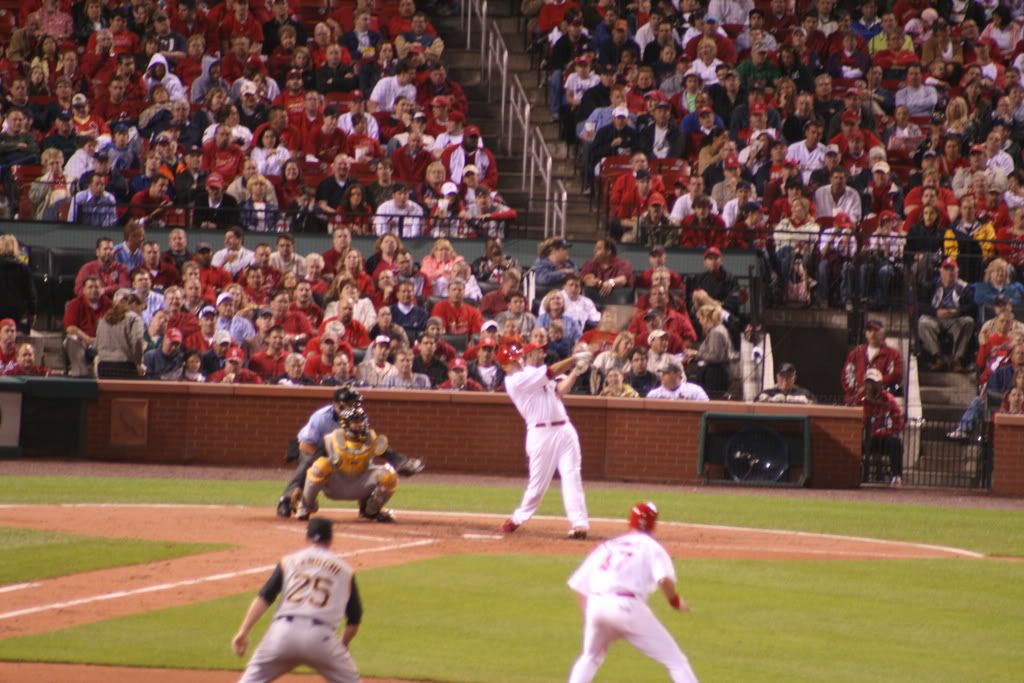
Phil Dumatrait was cruising until the bottom of the sixth inning, when Troy Glaus came to the plate with two outs and two runners on. Glaus has struggled so far in his tenure with St. Louis, but came through with a blast that just made it over the left-centerfield wall to give St. Louis the lead. Here is what Glaus' follow-through looked like from the seats my friends and I claimed via adverse possession:


[as always, you can click on the picture for a larger view]

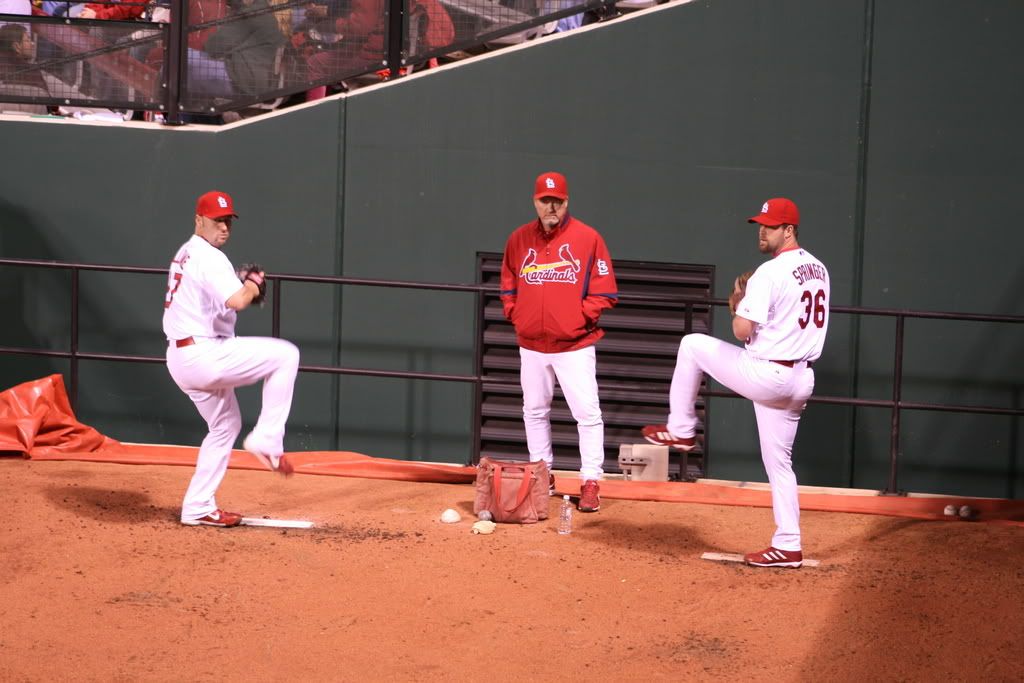
The Cardinals lead did not last long, as the wheels started to wobble for Kyle Lohse in the seventh and he gave up another pair of runs. Albert Pujols did his thing in the eighth, though, and tied the game with a bomb to leftfield. The Cardinals had great opportunities to put the game away, with runners on first-and-third after the Pujols homer in the eighth and a bases loaded situation in the ninth, but the game was destined for extra innings. Late in the game I leaned over the Cardinals bullpen and took this picture:


"Ok, whoever wants to blow the game tonight, raise your right leg. Great, go out there and do your thing, Villone."

I'm not even going to go into what happened in the tenth, but suffice it to say that it was ugly. Villone was allowed to pitch the entire inning and gave up four runs on four hits and two walks.

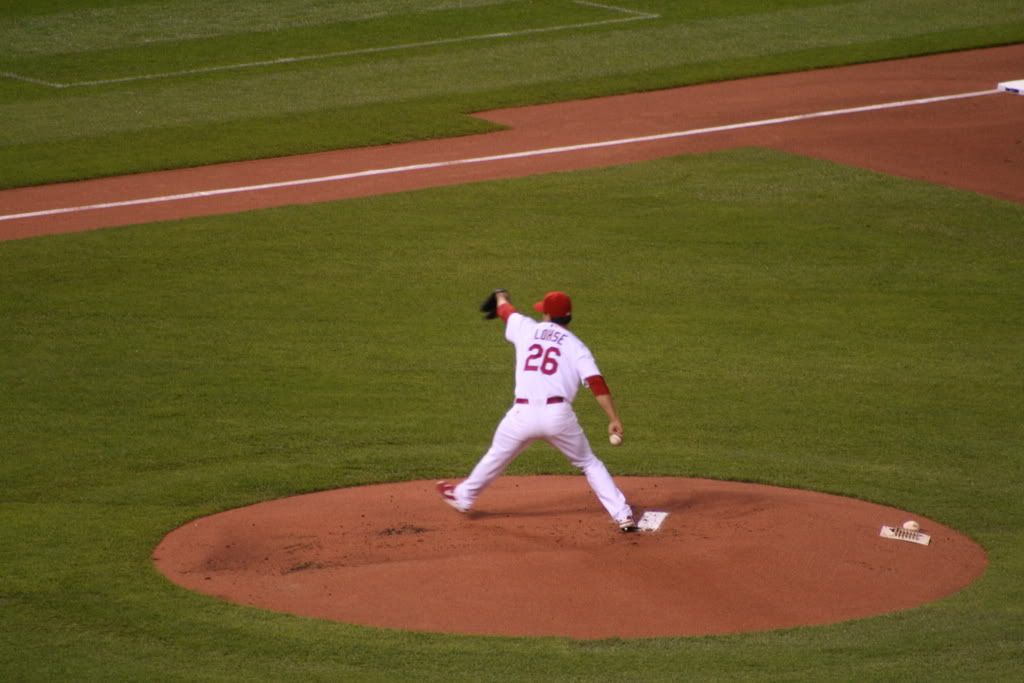
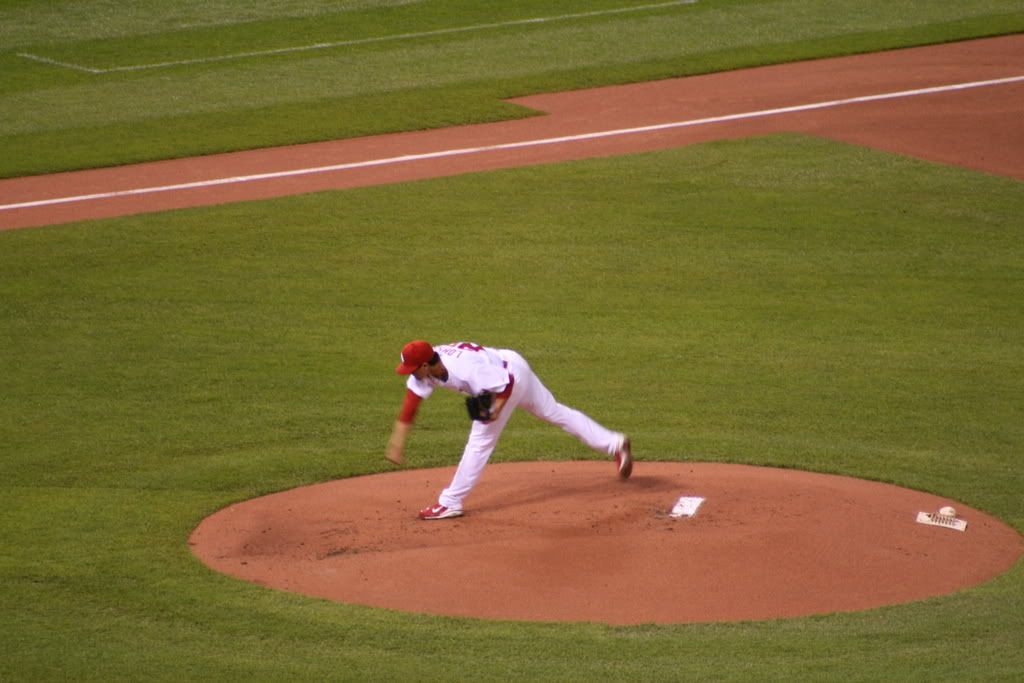
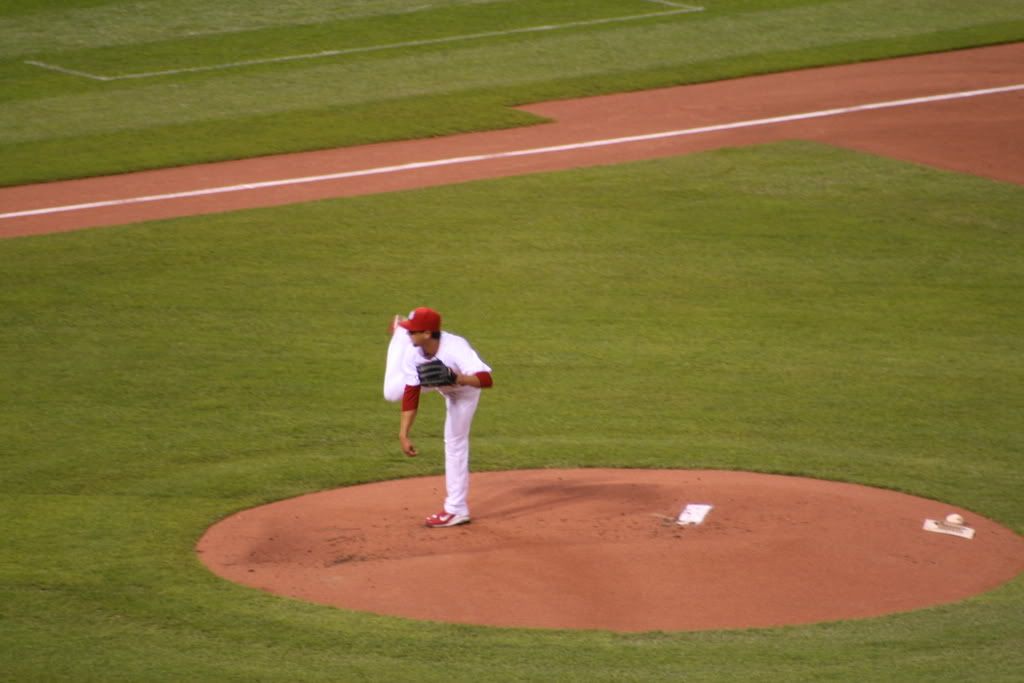
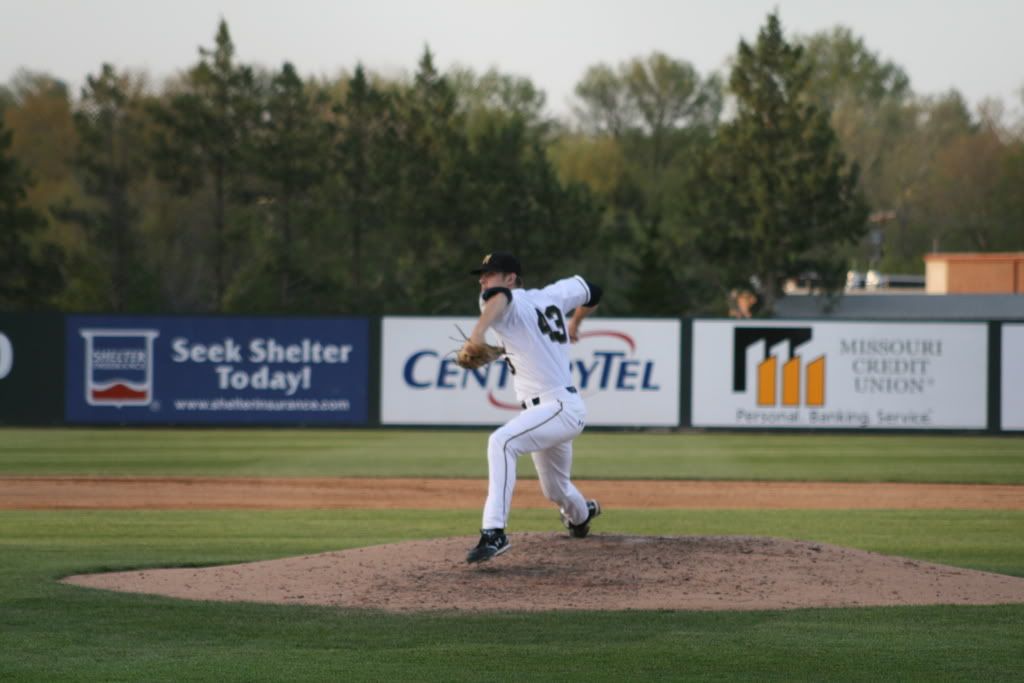
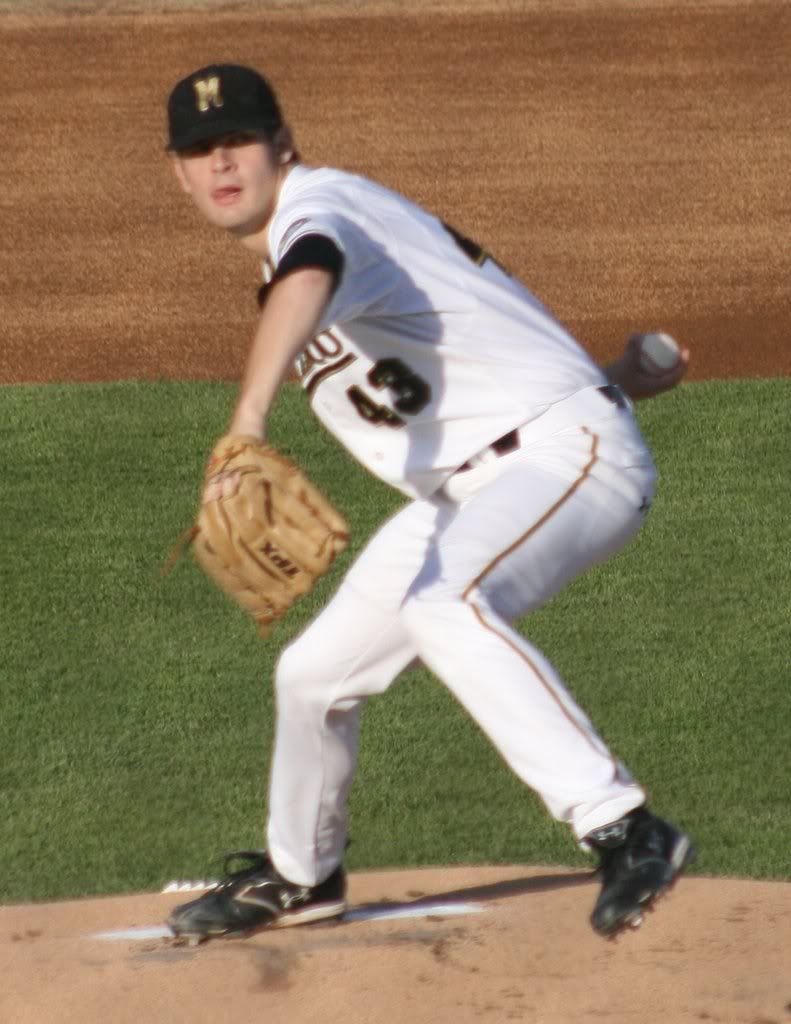
And finally, just because it is one of my favorite things to take pictures of, here is a sequence of Kyle Lohse's pitching motion, which looks pretty clean to me.


Saturday, May 3, 2008

Watched: Kansas State @ Missouri

I finally got around to making the trip to Columbia to see the Tigers (and especially Aaron Crow). The Tigers have been in a little bit of a slump, dropping their national ranking from #4 to #15. Aaron Crow was on the mound on Friday and they hoped to change their luck.

Aaron looked pretty strong in the first few innings, despite giving up a run in each of the first two. Aside from a double to lead off the game, Kansas State's hits were all ground balls that found their way through the infield. Crow combined an overpowering fastball with a wipeout slider to rack up the strikeouts.

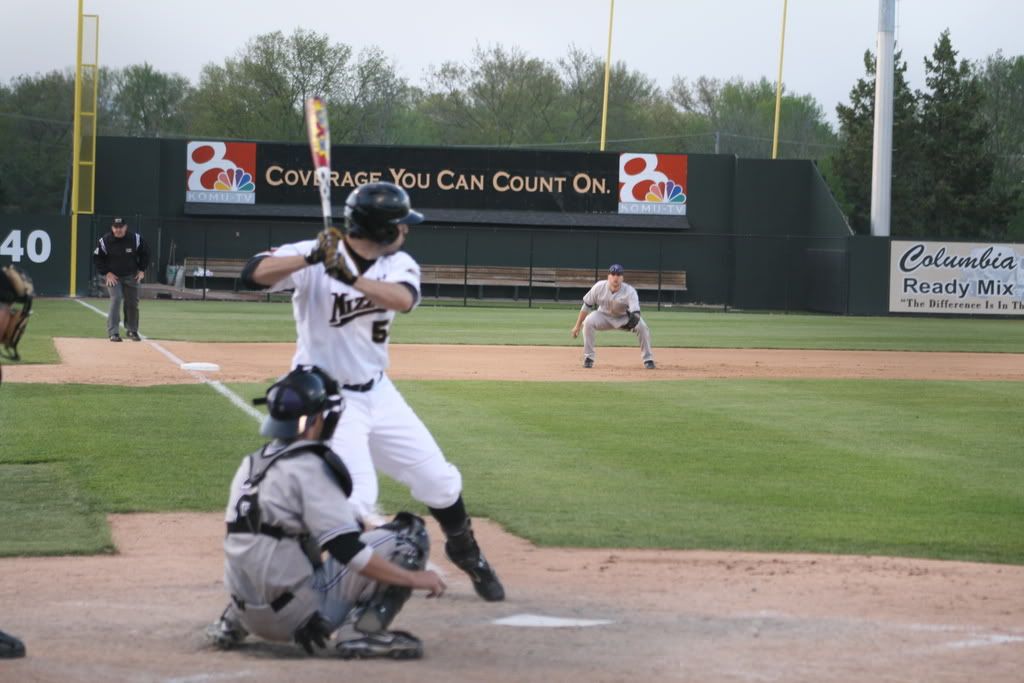
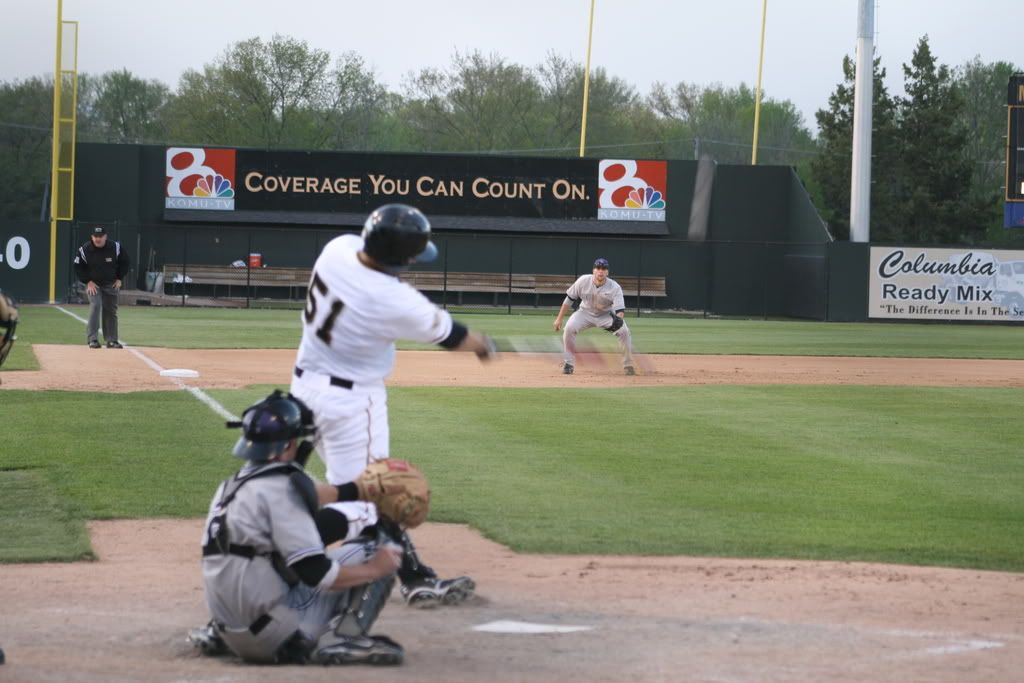
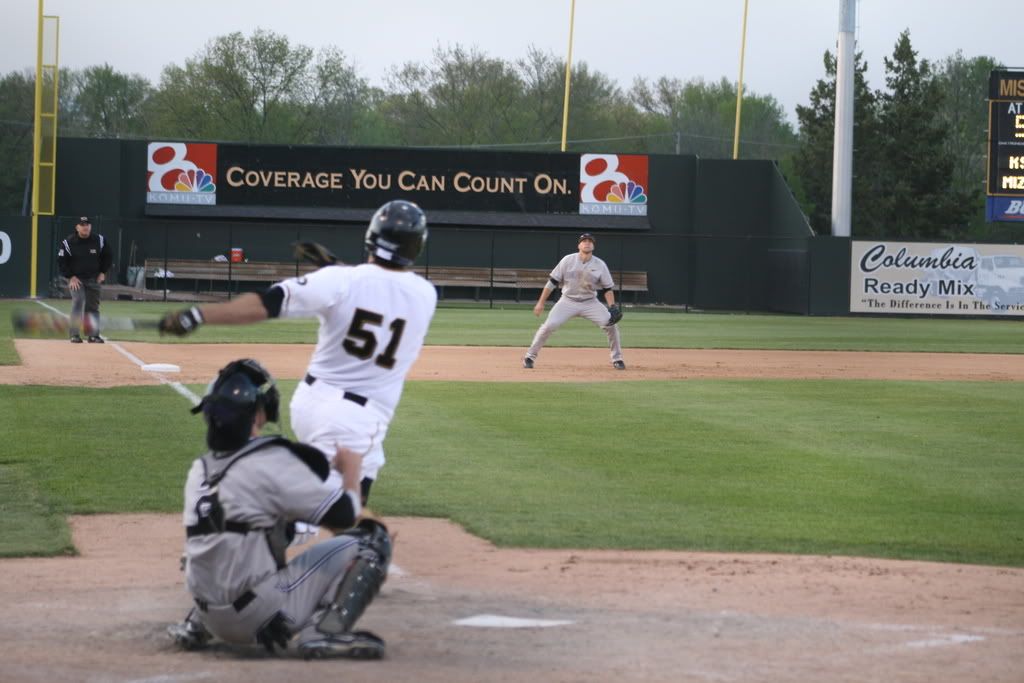
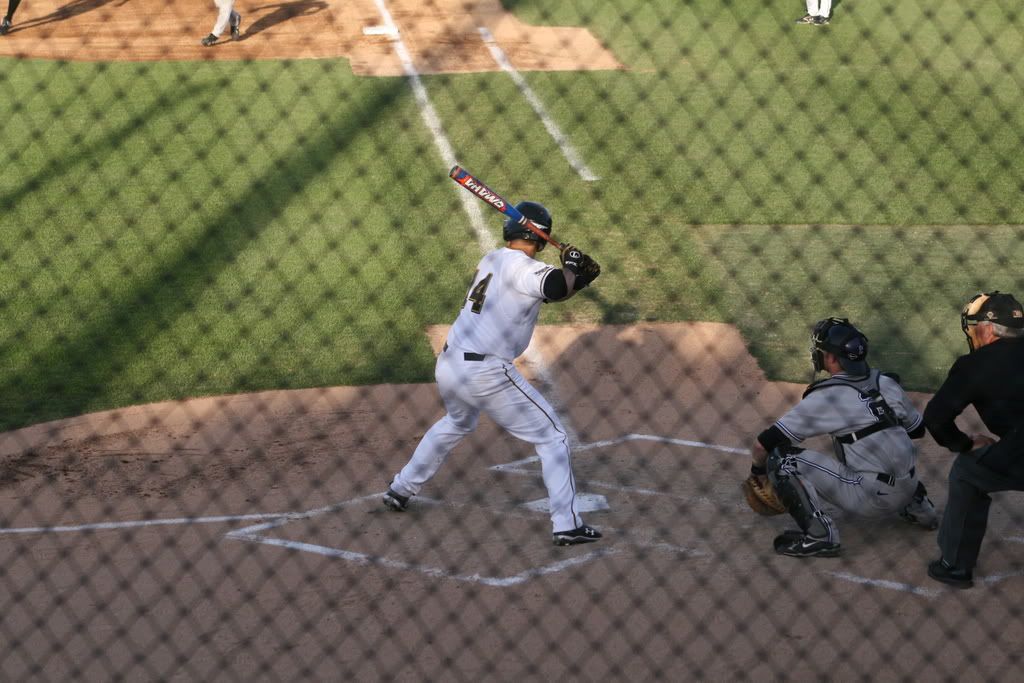
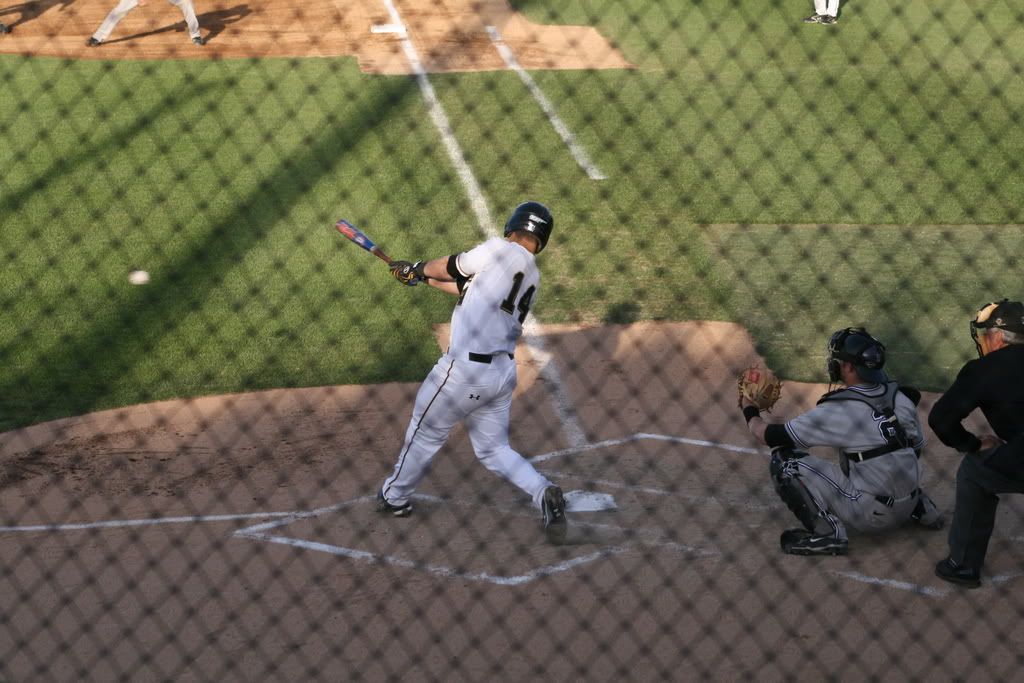
The Mizzou offense was firing on all cylinders early, as well. After two innings the score was 7-2 and Aaron Senne and Jacob Priday had both homered. Priday would add another later, as would Trevor Coleman and Ryan Lollis. Here is a three picture sequence of Priday's second homerun:


The leftfielder never moved [Note: you can click on the pictures for a full-sized view].

Mizzou held on to win 13-10, but the story was Aaron Crow. He seemed to have the ability to 'turn it on' and become dominant when he needed to, but other times he seemed to lose focus. Maybe he was just hurting, though. Crow came out of the game in the sixth inning with an injury. It looked to me like he was grabbing at his lower back. [UPDATE: It has been reported that he had muscle spasms in his back, which as far as I know did not recur during the rest of Missouri's season] I hadn't noticed any deterioration in his stuff, but he had been a little wild in the inning (in which he gave up 3 runs - two earned - and left with men on first and second).

There are some concerns about Crow's mechanics - check out this picture of his delivery where his throwing elbow is above his throwing shoulder:


I believe that is what Chris O'Leary would call an 'inverted W', which is a warning sign (according to Chris). In the link above for Chris O'Leary, he breaks down Crow's delivery and explains why the 'inverted W' is a bad thing. He also talks about a red herring in Crow's delivery: the wrist wrap. O'Leary's conclusion is that the wrist wrap is not a red flag, and that may be, but it is odd looking in person:


I have to admit that I was a little disappointed in seeing Crow in person. He has been tabbed as a top five pick in the draft, but he was far too inconsistent to me. His flashes of dominance showed what he is capable of, but I'm not sure that is enough for a top five pick.

As a bonus, here is three picture sequence of Trevor Coleman ripping a pitch into leftfield:


Coleman is a switch hitting catcher who hits for power and average from both sides of the plate. He seemed to handle himself well behind the plate, too, as he threw out a runner trying to steal and did a good job of blocking pitches in the dirt. He is only a Sophmore this year, but I would expect him to get some early draft consideration in 2009.

Thursday, April 24, 2008

Pitch f/x and Colorado

A few weeks ago I wrote a post about the percentages of pitch types thrown by the top pitchers in baseball. I was going to do a similar post about the pitch types seen by the top hitters when I got sidetracked by a portion of the research that I was doing.

I was combining the types of fastballs that the hitters had seen (normal fastball, sinker, and cutter) to get a sense of which hitters had seen the most off-speed pitches when I found that Matt Holliday's numbers stuck out like a sore thumb. 70.62% of all pitches that Holliday saw last year were fastballs, sinkers or cutters. I was comparing the top 20 homerun hitters last year and the next five highest results were:

2) Ken Griffey, Jr. - 63.9%
3) Ryan Braun - 63.69%
4) Adam Dunn - 62.16%
5) Lance Berkman - 62.09%
6) Carlos Lee - 62.01%

Aside from Holliday's 70.62%, the rest of the top 20 were fairly evenly distributed between 50.23% (Ryan Howard) and those listed above. So I wondered if this anomaly extended to other hitters for the Rockies - here are the percentages for the top eight Rockies hitters by at bats in 2007:

1) Matt Holliday - 70.62%
2) Troy Tulowitzki - 63.23%
3) Garrett Atkins - 64.37%
4) Todd Helton - 65.48%
5) Brad Hawpe - 65.16%
6) Kaz Matsui - 65.93%
7) Yorvit Torrealba - 59.68%
8) Wily Tavarez - 68.47%

Except for Torrealba and Tulowitzki, all eight are higher than any of the top 20 homerun hitters from last year. I then looked up the league average, and the percentage was 60.85. It is clear, then, that the Rockies are seeing a significantly larger amount of fastballs than the rest of the league.

I then turned to the Rockies pitchers, to see if they were throwing a larger percentage of fastballs than the league average. Here is the top five Rockies pitchers, as ranked by innings pitched in 2007:

1) Jeff Francis - 57.49%
2) Aaron Cook - 52.38%
3) Josh Fogg - 61.99%
4) Jason Hirsch - 56.85%
5) Taylor Buchholz - 60.87%

Only Josh Fogg threw more than the league average and he barely threw 1% more than the average. Interestingly, though, except for Taylor Buchholz (who only throws fastballs and sliders), the Rockies pitchers did not throw more breaking balls. Jeff Francis, Josh Fogg and Jason Hirsch relied on the changeup, while Aaron Cook threw the splitter as his primary second offering. The league average for changeups is 12.84% and Francis, Fogg and Hirsch threw 28.54%, 25.28% and 22.6% respectively (Aaron Cook threw 22.71% splitters compared with a 2.18% league average).

The conclusion we can draw from this is that the commonly-held belief that breaking pitches are less effective at altitude, whether it is scientifically accurate or not, has taken hold in major league baseball. The Rockies response to that belief, however, is different from that of the rest of the league. The Rockies pitchers do not throw more fastballs in response, they throw more changeups. I can't say whether this response is calculated or not. Perhaps the Rockies came to this conclusion and acquired and developed pitchers with good changeups or perhaps the Rockies stumbled into this response.

The real question is whether the strategy works, and by the numbers it certainly appears to. There was a lot of publicity about how the humidor in Colorado was keeping the scoring down and while that may be true, that should be true for the home team as well as the visiting team. This difference in strategic reactions to the belief that breaking pitches are ineffective at altitude should show up in the home and away splits for the offense and pitching of the Rockies.

At home last year the Rockies scored 478 runs, or about 25% more than they scored on the road. The Rockies gave up 396 runs at home last year, which is only 9% more than they gave up on the road last year. It is unsurprising that the Rockies pitchers would cope with the park effects of their home park better than their opposition, even without a different strategy, but it hardly seems reasonable that "home cooking" could account for a 16% difference.

There has been a lot of research into park factors and the development of park-neutral statistics. What those numbers don't take into account, however, is that some of those factors are impacted by the way teams construct their rosters and design strategies to make the unique aspects of their parks work in their favor. In Colorado's case, it certainly appears that they are addressing the aspects of Coors Field in better ways than their opposition, which gives them an advantage.

Tuesday, April 22, 2008

Watched - Matt Morris

I can't say that I exactly feel bad for Matt Morris - he has earned $56,311,850 playing baseball (according to ESPN.com) - but there is something sad about watching the downside of his career. Matt was the 12th pick overall in the 1995 draft by the St. Louis Cardinals. He came up two years later and finished second to Scott Rolen in the Rookie of the Year balloting. He was injured in 1998 and missed all of 1999 after having Tommy John surgery. He came back in 2000 and made 31 appearances in relief.

Matt broke out in 2001, winning 22 games and striking out 185 batters while posting a 137 ERA+. He was third in the Cy Young balloting. At the age of 26, the Cardinals thought they had found their Ace for years to come. But 2001 was the last time that Matt put together a truly great season. He was very good in 2002, with a 117 ERA+ and striking out 171, but thereafter settled into the "solid, but unspectacular" category, reaching double digits in wins every year and eating a lot of innings, but never dominating. He was an integral part of the Cardinals teams that led the majors in wins in 2004 and 2005, but he wasn't their best pitcher. Many people viewed him as the heart and soul of the pitching staff, though.

I think what I like so much about Matt is that he had been great and had great potential and even though injuries and age sapped him of that potential greatness, he still gave everything he had and found ways to be a successful pitcher. What makes me sad about Matt is that he was not on the Cardinals team that won a World Series in 2006. He was so much a part of the build up to that World Series - the close calls in 2004 and 2005 - that he seemed like he should have been celebrating with the team on the field in 2006.

I watched Matt's start last night against the Florida Marlins for old time's sake. Unfortunately, the experience was a little depressing and made me feel old (I am about two months older than Matt). During his early, dominant, years, Matt threw in the low 90's with his fastball and had a put-away 12-6 curveball. As he settled into his career, his fastball was about 89-91 and he still had a great curveball. He also learned to mix in a cutter to give hitters a different look. Last night Matt had the same repertoire, just slower. His fastball was anywhere from 83 to 88 (but it still had great movement), his cutter was in the upper 70's, and his curveball was in the upper 60's. The curve had a bit of a loop to it and he hung a couple.

Matt is clearly not the pitcher he was even three years ago, but I think that it is possible to be a league average pitcher with the stuff that he has. He is willing to throw any of his pitches on any count and if Matt could locate his fastball on the corners and low in the strike zone, he can still be successful. Unfortunately, Matt's biggest problem last night was that he couldn't locate any of his pitches consistently.

Matt lasted only four innings, giving up eight runs on nine hits, a walk and a hit batsman. He struck out two and threw 99 pitches. He gave up a couple of homeruns, the first to Hanley Ramirez on a 71mph hanging curveball that looked like it had been set on a tee for Ramirez. The second was on an 83mph fastball that was right down the middle to Josh Willingham. The first homer didn't bother me as much as the second. When a pitcher relies on his curveball as much as Morris does, he will hang a few on occasion. The pitch to Willingham, though, looked like Matt was just out there throwing batting practice. Unfortunately, it looked like that a lot in the four innings Matt threw. Almost all of the nine hits were hit hard - he also gave up 5 doubles - and seven of the nine hits were off of the fastball.

I hope for the best for Matt, because he has always been one of my favories, but the Pirates can't afford to keep sending him out there the way he's been pitching - no matter how much they are paying him.

Friday, April 18, 2008

Miguel Tejada and Gotcha Journalism

By now you have probably heard that Miguel Tejada is two years older than previously thought. He lied to the Oakland A's when he was first signed as an amateur because of the pressure to find a way out of poverty. The excuse doesn't make it right, although my guess is that the A's, or any of the teams that have signed or traded for him since, would not have changed their decision based on the two year jump in age (Houston might not have been willing to give up such a big package for him, but then again, we are talking about Ed Wade).

The issue for me, though, is how this story was broken (which makes this post less about baseball and more about journalism, sorry). ESPN set up an interview with Tejada and sat him down in front of a camera and asked him how old he is. Tejada seemed a bit confused by the line of questioning, expecting the interview to be about his new team or the start of the new season. When Tejada answered that he is 31, the questioner asked if he was sure and then pulled out a birth certificate showing that Tejada was born in 1974, not 1976. Tejada then became very confused, then upset. He said something to the effect of "I didn't come here to talk about this kind of thing," and then took off the lapel microphone and left.

This kind of journalism sickens me. The story is legitimate news, but why does ESPN think it has to pull the Jerry Springer move with Tejada to break it? They brought Tejada in under false pretenses and then ambushed him with embarrassing information. Is that entertainment? ESPN should be ashamed that they have turned to this kind of gutter journalism to get a cheap pop.